Deploy an agent
Get an AI agent into production.
Teams rarely stall on the model. They stall on the path around it: where the agent sits, how it talks to the product, what data it is allowed to see, and who is on the hook when it is wrong on a Monday morning.
Accelerate Data is software consulting for that path — architecture, application work, data plumbing, and production operations. Those are the four offers we already do. Grok Bot is one inspectable example of an agent we can help you deploy. It is not a product we sell, not a fifth offer, and not the name of this page.
What the deploy path actually is
A demo on a laptop is not a deploy. A deploy is a system that runs in the stack your team already operates: identity, data, application surfaces, logs, and the people who have to live with it after the pilot deck is closed.
That work maps to the consulting we already sell. We do not add a fifth offer because an agent showed up. Software Architecture & Strategy decides the shape. Custom Application Development puts the agent in the product. Data Engineering feeds it context it can trust. AI & Intelligent Systems makes the model path hold up under real use.
The buyer question is not “which chatbot should we try.” It is “what would Accelerate actually do if we wanted this running.” The answer is the four layers below, in that order, with enough overlap that the same engagement usually touches more than one.
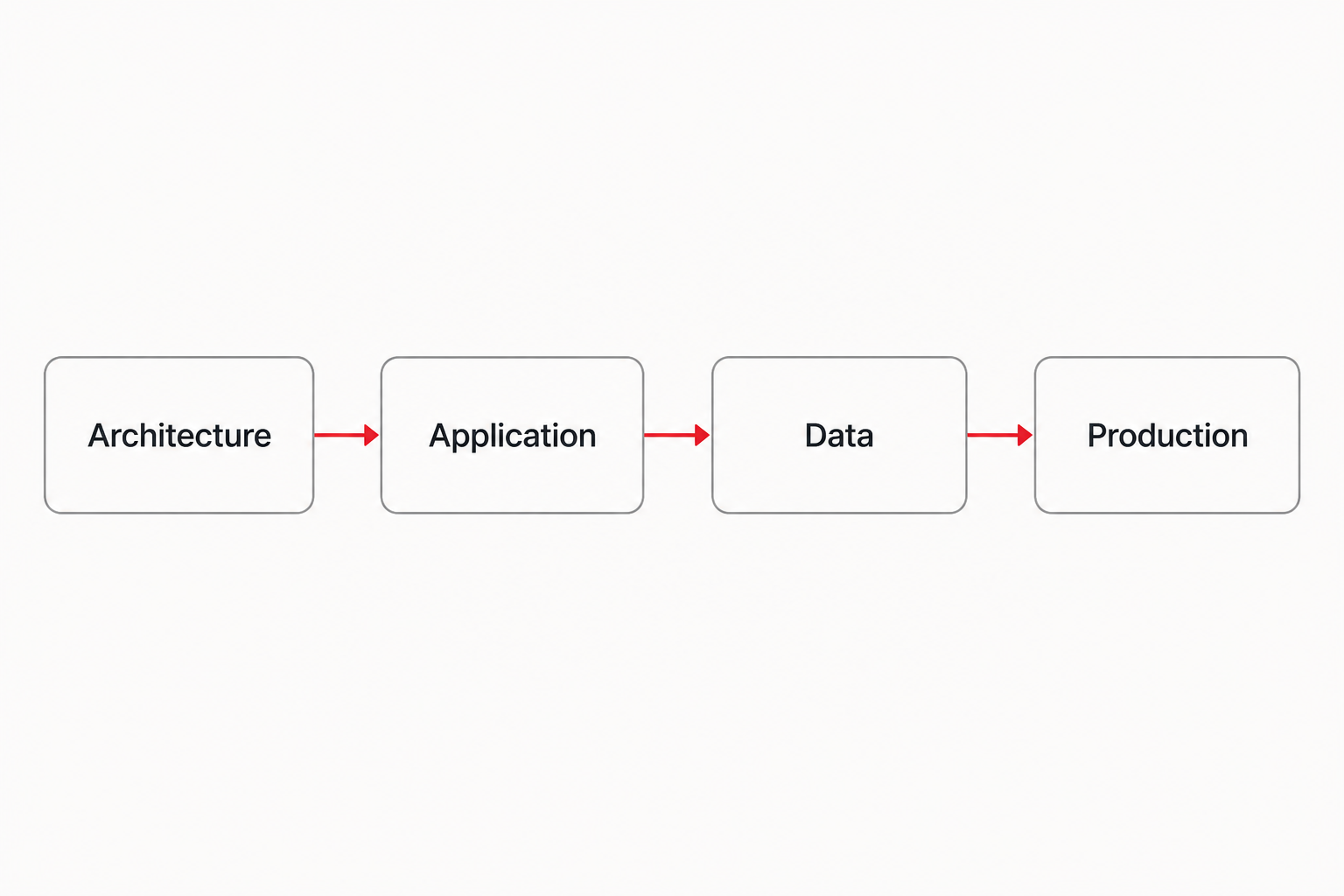
Architecture — decide what the agent is allowed to do
Before anyone wires a model, someone has to decide the system. Where does the agent sit relative to the apps you already run? What is it allowed to call? What stays a human decision? What happens when a tool fails, a prompt is poisoned, or the agent takes a step it should not?
That is Software Architecture & Strategy. We sit with the constraints you already have — existing systems, delivery pressure, the decisions that are expensive to undo — and we draw the boundary before the wrong one ships. The output is not a slide about agents. It is a shared technical direction your engineers can execute: interfaces, trust boundaries, failure modes, and the sequence of work.
On an agent deploy, that usually means naming the runtime, the tools, the approval gates, and the systems that are explicitly out of scope. If the architecture is vague, the application work invents it under pressure, and production inherits the mess.
Application work — put the agent in the product
An agent that lives in a side chat nobody opens is not in production. Production means the surface your team already ships: the API, the workflow, the UI, the job that already has users.
That is Custom Application Development. We write the code — auth, session, audit log, approval UX, the glue between the agent and the application — from first commit through production. Your engineers stay in the loop. You keep the product knowledge; we help you get working software out the door.
The application work is also where “the agent can do anything” gets reduced to a few actions the product can stand behind. If a step needs a person, the product has to show that. If a step is automated, the product has to log it. That is application engineering, not a prompt.
Data plumbing — give it the right context
Agents fail in boring ways when the data is wrong. Stale records. Permissions the model should never have. A prompt stuffed with whatever was in the last ticket. Retrieval that looks fine in a demo and lies in production.
That is Data Engineering. We design the layer production software depends on: how data moves, where it lives, who can read it, and how it stays trustworthy as the system grows. Pipelines, access, freshness, and the retrieval path — infrastructure your team can run, not a black box they inherit.
For an agent, this is the difference between a model that talks about your business and a system that is allowed to act on it. If the data path is not designed, every later “AI” task is someone pasting context by hand.
Production operations — keep it running
The model is one piece. The rest is evals before you ship, monitoring after you ship, a way to roll back, cost and rate limits, and a clear stop when the agent should ask a person.
That is AI & Intelligent Systems, done as production work. Practical integration — LLMs, agents, pipelines, workflows — with reliability as the bar. We work alongside your team on how the system is built, operated, and changed. A demo that falls over the first time the data is messy is not the engagement.
Operations is also where ownership gets explicit: who gets paged, what “good” looks like, and how the agent is updated without surprising the rest of the stack. If that work is skipped, the agent stays a laptop demo with a production URL.
An inspectable example: Grok Bot
Grok Bot, from xAI, is durable AI teammates on a persistent cloud computer — messaging, approvals, connectors, and routines. It is not the same as chatting with Grok on grok.com. A team that wants an agent like that running against their tools still has to do the consulting work this page describes: architecture, application integration, data access, and production operations.
Accelerate Data does not sell Grok Bot. We do not list it as a SKU, a store item, or a fifth offer. It is one inspectable example of an agent we can help you deploy into the systems you already operate. If your agent is a different model, a different runtime, or something you are building yourselves, the path is the same.
How a call works
Book a 30-minute call. We talk about the agent you want running, the systems it has to live in, and whether the work is architecture, build, data, operations — usually more than one. You leave with a clearer picture of the path, not a product package.
If it is a fit, the next step is the consulting work above, alongside your team, not above it. If it is not, you will hear that on the call.